
NXRS 2026 will include a set of friendly contests for fliers who want to add a little extra challenge, creativity, precision, or persistence to the weekend.
These contests are intended to be fun, accessible, and compatible with normal NXRS flight operations. Contest flights must still meet all launch safety requirements, waiver limits, range procedures, and launch staff direction.
Some contests require the flier to declare their entry before flight.
How to Enter
For contests that require an individual flight entry, the flier must:
- Declare the contest entry on the flight card before the flight.
- Make the declaration before RSO inspection.
- Fly within all applicable NXRS, OROC, and Tripoli safety rules.
- Recover the rocket safely.
- Submit any required altimeter data or post-flight information.
RSO means Range Safety Officer. The RSO has final authority over whether a flight is approved for launch.
AGL means above ground level. AMSL means above mean sea level.
Divisions
Where divisions are used, the divisions are:
- Junior – 17 and under. Low power, also High-Power under the Tripoli Mentorship Program and NAR Junior HPR Level 1 programs.
- Senior – 18 and up. Only members are TRA, NAR, CAR, Etc orgs with reciprocity with Tripoli can fly at Tripoli sanctioned events.
Contest List
Most Beautiful Rocket
Contest type: Crowd vote
Entry required: Yes
Divisions: Junior and Senior
Putting the show in NXRS.
The Most Beautiful Rocket contest is for rockets that bring craftsmanship, finish, creativity, visual impact, or general crowd appeal to the flight line.
To qualify:
- The rocket must be present at NXRS 2026.
- The rocket must be flown at NXRS 2026.
- The flier must declare the rocket as a Most Beautiful Rocket entry on the flight card.
- The rocket must be safely recovered.
Build photos, forum posts, and email-list threads are encouraged before NXRS to help fliers show their projects and build interest, but advance promotion is not required to win.
Voting will be conducted by an online poll available during NXRS.
QR Codes are posted at the event so attendees can vote.
The rocket receiving the most votes wins.
Final Results:
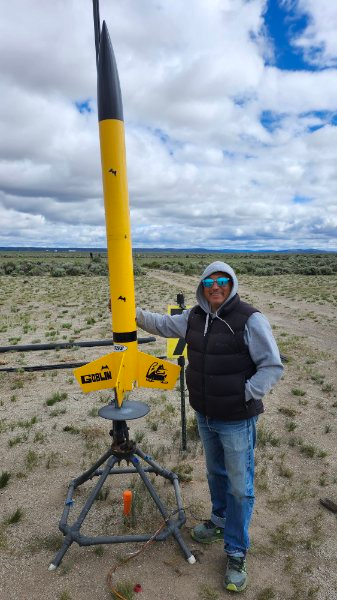
Senior Division:
Brett Phillips – Stretch Goblin
Brett wins the Limited-edition Estes Saturn V kit – donated by Gary Lech
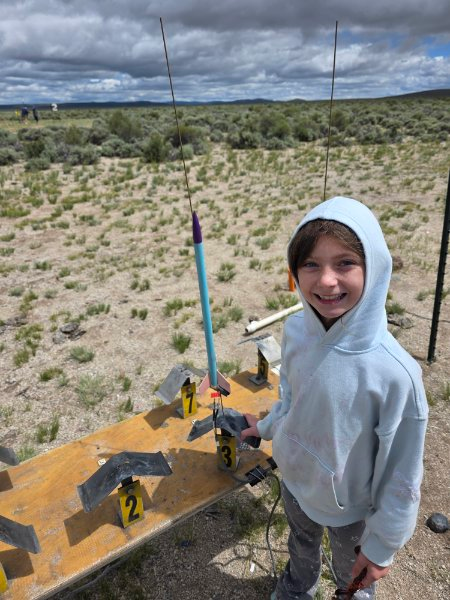
Junior Division:
Harper Ray – Epic Two
Harper wins $50 credit at Flight Line Rocket Shop
Mt. Hood Challenge
Contest type: Target altitude
Entry required: Yes – written on flight card prior to flight.
Divisions: Junior, and Senior
The Mt. Hood Challenge is a precision altitude contest based on Oregon’s highest peak.
The goal is to fly closest to the target altitude. Flights may be over or under the target. The closest verified altitude wins.
The flight must carry an altimeter, and the rocket must be safely recovered so the altitude can be verified.
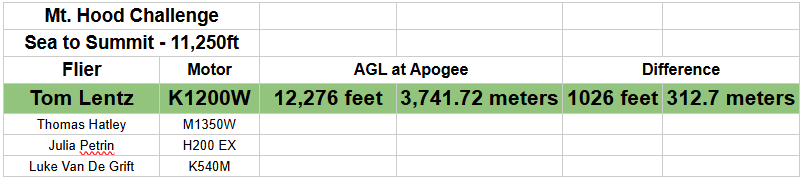
Mt. Hood Sea to Summit
Target altitude: 11,250 ft AGL
This category represents a flight from sea level to the summit of Mt. Hood.
Final Results:
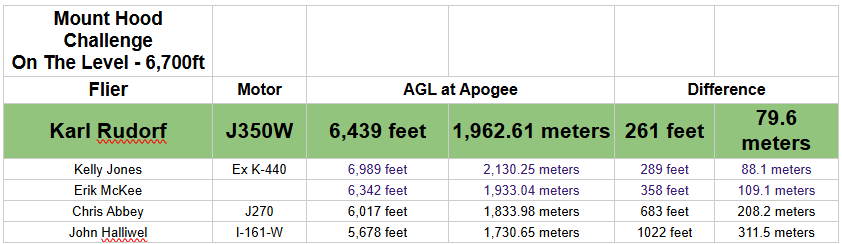
Mt. Hood — On the Level
Target altitude: 6,700 ft AGL
This category represents a flight from the OROC Brothers launch site elevation to the summit of Mt. Hood.
Final Results:
Reference Data
- Mount Hood elevation: approximately 11,249 ft AMSL
- OROC Brothers launch site elevation: approximately 4,533 ft AMSL
- Brothers, Oregon elevation: approximately 4,639 ft AMSL
- Timberline Lodge base elevation: approximately 4,000 ft AMSL
- Timberline upper lift elevation: approximately 8,540 ft AMSL
Scoring
For each Mt. Hood Challenge category, the score is the absolute difference between the target altitude and the verified actual altitude.
Closest verified altitude wins.
Example:
- Target altitude: 6,700 ft AGL
- Actual altitude: 6,612 ft AGL
- Score: 88 ft from target
Lower score is better.
Apogee Accuracy Achievement
Contest type: Predicted altitude accuracy
Entry required: Yes – written on flight card prior to flight.
Minimum flight altitude: 1,000 ft AGL
Divisions: Junior, and Senior
The Apogee Accuracy Achievement contest rewards fliers who can accurately predict the altitude their rocket will reach.
Fliers must launch a rocket carrying an altimeter to at least 1,000 ft AGL.
Before flight, the flier must:
- Enter the predicted altitude on the flight card.
- Note that the flight is an entry in the Apogee Accuracy Achievement contest.
After safe recovery, the flier must submit:
- Predicted altitude
- Actual recorded apogee
- Altimeter data or other verification requested by contest staff
The contest score is the percentage difference between the predicted altitude and the recorded apogee.
Formula:
Percent Error = |Predicted Altitude − Actual Altitude| ÷ Actual Altitude × 100
The flier in each division with the lowest percentage error wins.
Example:
- Predicted altitude: 4,800 ft AGL
- Actual altitude: 5,000 ft AGL
- Difference: 200 ft
- Percent error: 4.0%
Lower percentage error is better.
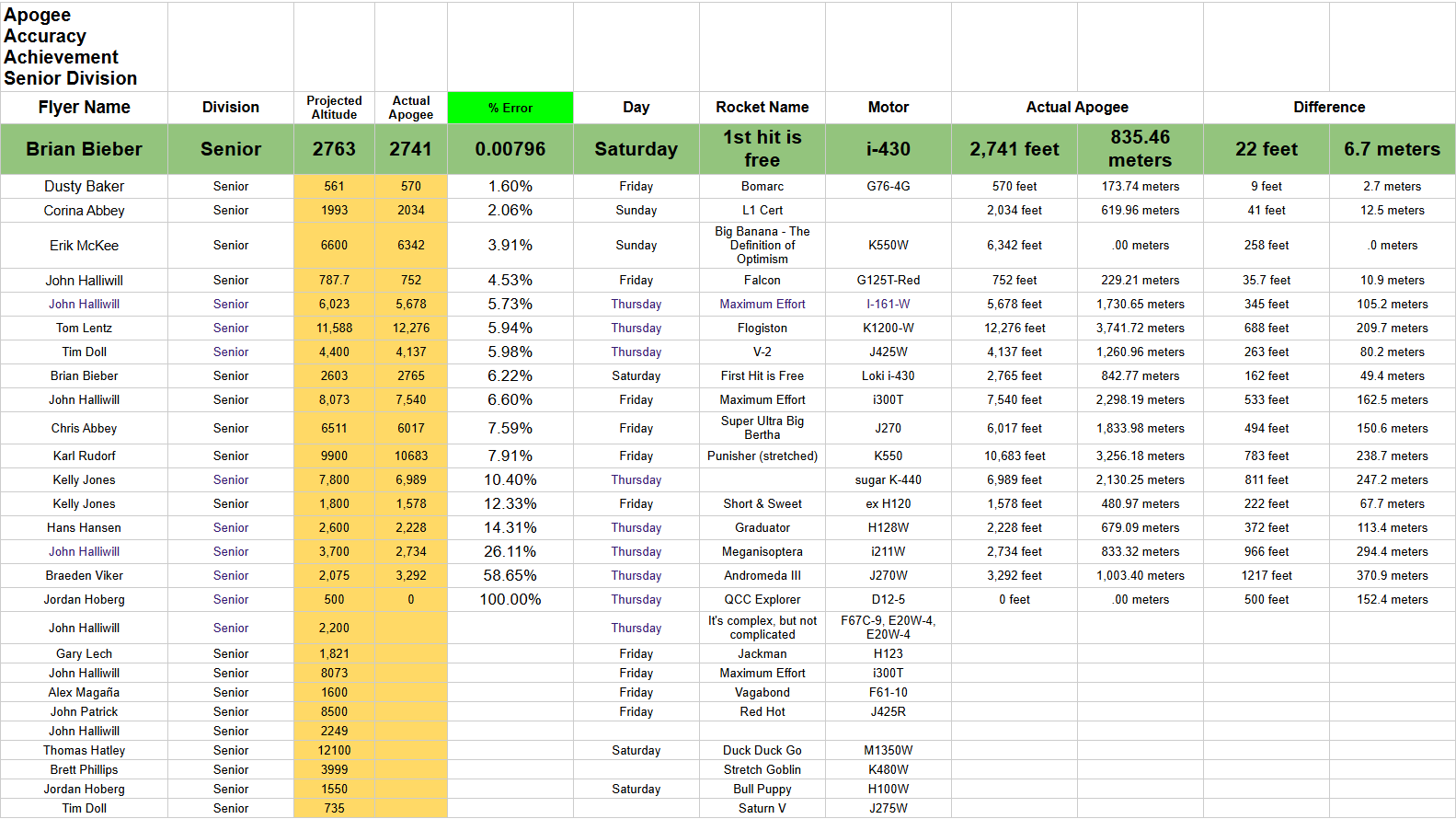
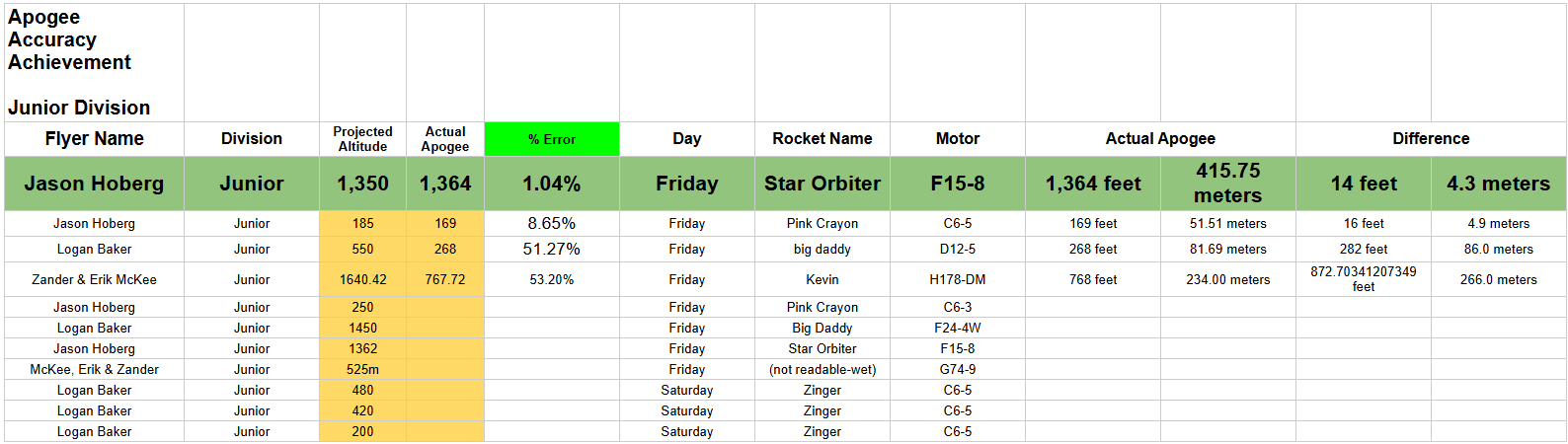
Final results:
Senior division:
Brian Bieger wins the 24″x32″ rolled print poster of a Gemini Titan lift off – donated by Tsolo Dann
Junior division:
Jason Hoberg wins the 24″x36″ rolled print poster of International Space Rockets – donated by Tsolo Dann
Mucho Motor
Contest type: Most motors flown
Entry required: No – just fly something at NXRS
Divisions: Junior and Senior
Mucho Motor recognizes the flier who flies the most motors during the NXRS weekend.
All fliers are entered by default.
Results will be collected by flight-card review. Each motor flown by an individual flier during NXRS counts toward that flier’s total.
Clustered flights count by the number of motors flown, not by the number of rockets flown. So, someone could in theory make a complex M cluster of 2,328 Estes A3 motors (2.2Nsec each) as an entry. Subject to RSO/FSO, etc. Or, fly a single A3 powered rocket 2,328 times… for the same number of points.
The flier with the highest total motor count during NXRS wins.
The Winner of Mucho Motor:
With 6 flights, flying a total of 38 motors, Tsolo Dann!
Tsolo wins $50 store credit at Flight Line Rocket Shop
Darwin Fair flew 23 motors over 17 flights,
Tim Doll flew 22 motors over 14 flights,
Jason Hoberg flew 16 motors over 15 flights!
Bean Loft Challenge
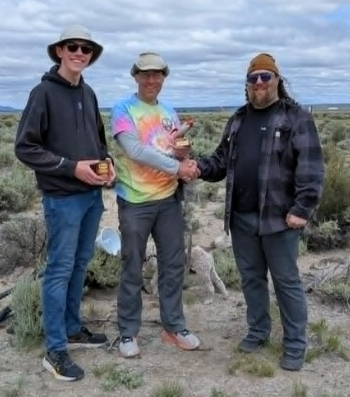
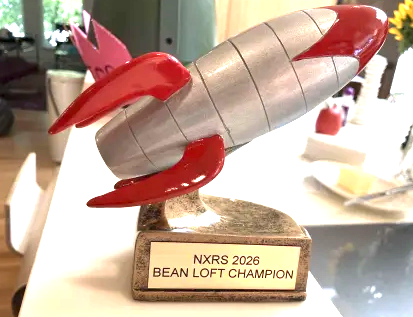
Project Icarus conducted the Bean Loft Challenge.
The winners are Erik and Zander McKee, who launched, recovered, and completed eating the beans in 22 minutes, winning the illustrious trophy.
Prizes
At this time, the NXRS 2026 contest prize pool includes:
- Tinder Rocketry “The Peregrine” CO2 redundant deployment system – donated by Kelsey Black
- Wildman Rocketry Cherokee Mini kit – donated by Tom Lentz
- Limited-edition Estes Saturn V kit – donated by Gary Lech
- Madcow Rocketry Mini Black Brant II fiberglass kit- donated by Brant Hendrickson
- 24″x32″ rolled print poster of a Gemini Titan lift off – donated by Tsolo Dann
- 24″x36″ rolled print poster of International Space Rockets – donated by Tsolo Dann
Additional prizes are welcome.
If you would like to contribute to the prize pool, please contact the OROC Promotions Director.
Depending on the available prize pool, contests may award first place only, first place and runner-up, or first, second, and third place. Some contests may be awarded for recognition only if material prizes are not available.
General Contest Rules
These rules apply to all NXRS 2026 contests unless a specific contest description says otherwise.
Safety and Range Authority
All contest flights must comply with:
- NXRS flight operations
- OROC range procedures
- The Tripoli Unified Safety Code
- Applicable waiver limits
- Launch Director direction
- RSO approval
The RSO and Launch Director have final authority over flight approval, safety decisions, and contest eligibility.
Contest rules may be changed, suspended, or cancelled due to safety, weather, fire risk, waiver limitations, staffing limitations, or other operational concerns.
Flight Eligibility
To be eligible for contest scoring:
- The rocket must be launched safely.
- The flight must remain within the active waiver for the pad location and time of launch.
- The rocket must be safely recovered.
- The rocket must be available for post-flight inspection if requested.
- Required flight data must be submitted when applicable.
Flights that exceed the available waiver are disqualified from contest scoring.
Flights that are not recovered are disqualified from contest scoring.
Flights that violate the Tripoli Unified Safety Code, NXRS rules, or launch staff direction are disqualified from contest scoring.
Contest divisions “Junior” and “Senior” refer to:
- Junior – fliers 17 and under – includes High power under the Tripoli Mentorship Program or NAR Junior HPR Level 1.
- Senior – fliers 18 and up – must be members of TRA,NAR, CAR, etc. orgs with reciprocity with Tripoli.
Data Verification
Flight performance contests may require altimeter, flight computer, or other recorded data.
Altitude, acceleration, duration, or other measured values are subject to verification.
Data must represent a nominal flight profile. Obvious sensor spikes, pressure artifacts, deployment-charge artifacts, Mach-related barometric errors, accelerometer anomalies, or other error-producing events may be rejected for contest scoring.
Contest staff may request the altimeter display, downloaded data, flight computer file, photo, or other supporting information.
Staged and Clustered Flights
Staged and clustered flights may be allowed when approved by the RSO.
All staged or clustered contest attempts should be brought to the RSO with enough time for proper review before the intended flight attempt.
The RSO has final say over staged and clustered attempts.
Oddrocs and Nonstandard Designs
Oddrocs and nonstandard rocket designs may be allowed with RSO approval.
Fliers planning to use unusual designs should bring the rocket to the RSO for review well before the intended flight attempt.
Reflights and Multiple Entries
Unless a specific contest says otherwise, fliers may make multiple contest attempts.
Each contest attempt must be declared on the flight card before flight.
A single flight may be entered in multiple contests concurrently.
Only eligible flights with successful recovery and acceptable verification data may be scored.
Volunteers
OROC members are encouraged to help support contest operations.
Some contests may require help with registration, flight-card review, voting, data verification, or prize coordination. If adequate volunteer support is not available, individual contests may be modified or cancelled.